

Oct 08, 2011
Raising Free Range Chickens - Necropsy & Disease Identification
Being able to perform necropsy of dead chickens and to identify diseases is crucial for the success of a chicken farm.
Delays in disease identification can lead to outbreaks resulting in high mortality and economic losses.
It is absolutely necessary for detail records to be kept from Day 0 until all the chickens are sold, for each batch. Detail records will enable us to analyse out trends and history, which together with the lesions in organs will help identify the many causes of poor weight gain, mortality, etc.
For example, trend analysis enabled us to identify a non-gumboro spiking mortality phenomenon in young chicks below two weeks old, which we ultimately traced to mosquitoes.
Dirgha Bahadur Tamang, from Nepal, has reached competency in necropsy and disease identification.

Dirgha receiving his certificates from Razaly, the farm director
We provide him with a 3 inch thick file of laminated pictures of the key clinical signs of various common chicken diseases. He uses the pictures as a reference and when he sees the start of infectious disease in culled chickens, he will raise the alarm for quick pre-emptive action.

Dirgha with his certificates and his file on common poultry diseases
We hope to be able to sponsor him for further studies to be a vet some time in the future.

Dirgha performing a necropsy on a young chick.
Oct 07, 2011
Spreading The Word II
Certificate in Biochar Production
Bal Bahadur Bishokarma, from Nepal, used to make charcoal for sale at his village using traditional pit methods. Since coming to our farm, he realizes that our methods are less wasteful and involves less physical work. He now knows the importance of planting trees for charcoal production rather than cutting down forest trees.
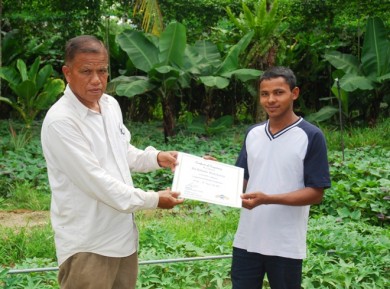
Here he is receiving his competency certificate from Razaly, the farm director.

At the farm, for each of the planted trees he cuts down for biochar (biochar is charcoal used for soil amendment generally using less 'dense' material) production, he has to plant five.
The tree of choice here at our farm is gliricidia sepium (for biochar) and acacia mangium (for charcoal). They are fast growing and hence are excellent carbon sequesters.
The resultant biochar has multiple uses at our farm. The main use is in the chicken litter to reduce free gaseous ammonia which can cause inflammation in the respiratory tracts of young chicks.
We have done tests at our farm to see if soil amended with biochar versus unamended soil has a difference in productivity. The results show no significant difference. The reason would seem to be that our soil is already very rich in microbial population and was never intensely cultivated. Perhaps in areas with less fertile soil and subject to repeated cultivation, biochar amendment may produce results as per the writings of many advocates.
At the farm, our biochar production is to reduce our carbon footprint by sequestering carbon (CO2) from our animals using fast growing trees. These trees are then used to produce biochar which are used in our poultry and aquaculture operations, and to filter discharge from our farm.
When Bal returns to Nepal, hopefully, he can make a living out of producing biochar and charcoal on a sustainable basis.
15:35 Posted in Biochar, Blog, Chickens | Permalink | Comments (0) | Tags: biochar, charcoal, ammonia reduction in chicken litter, pyrolysis, gliricidia sepium, acacia mangium, biochar production