



Oct 02, 2005
Fruit Bats - Home at DQ
Am so glad that Fruit Bats have decided to make our farm their home at last. They used to be transcient, roosting in bushes during fruiting seasons. Now, they seem to have decided at last to make the farm their permanent home. It speak volumes for the natural environment that is found in our farm - their endorsement is our sucess. We know some of our workers come from countries where bats are part of their cuisine. The only way to stop them was to inform them that the bats get rid of the dreaded aedes mosquitoes at the times that the mosquitoes are most active - early morning and late evening. We have seen the bats going for the mosquitoes in the twilight and early dawn.
 Click on the picture to view enlarged image.
19:45 Posted in Blog | Permalink | Comments (0) | Tags: Sustainable Agriculture
Sep 27, 2005
Olive Oil Chickens?
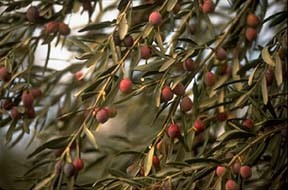 We all know the benefits of olive oil. At DQ, we are now experimenting with feeding olive oil to our chickens to see if we can increase the monunsaturated fats content for a healthier meat. Some of our customers had complain that our chickens are too dry and tough. We are doing research now with olive oil to see if we can achieve a chicken with more fat but fats of the right kind. That juicy, "smooth" chicken sold at the chicken rice stalls is full of those saturated fatty acids that have been implicated in heart disease, and full of omega 6 that have been implicated in many chronic diseases. See our previous post on Lab Tests.
Here's an article on the latest findings about olive oil:
"A compound found in olive oil called oleocanthal fights inflammation in a manner similar to ibuprofen, inhibiting the cyclooxygenase enzymes involved in pain and inflammation responses. The amount of oleocanthal obtained from daily olive oil consumption would elicit a much smaller anti-inflammatory effect compared to medication, and more research is needed to determine whether olive oil consumption has any clinical effect on inflammation. However, some researchers speculate that the heart benefits of a Mediterranean-style diet, which includes ample amounts of olive oil, may be due in part to the anti-inflammatory properties of olive oil. The inflammation of tissues, such as those of the vascular system, plays a role in the development of heart disease. A great way to add olive oil to your diet is to replace creamy salad dressing high in saturated fats with a drizzle of olive oil and balsamic vinegar. "
10:00 Posted in Chickens | Permalink | Comments (0) | Tags: Organic Farming
Sep 26, 2005
Preventive Measures - Flu
- Book with your doctor to be vaccinated as soon as the latest flu vaccine is available. There are some people who are not in favour of vaccination. If so, consider the other strategies below.
- Stock up on the human anti-viral Tamiflu. Do it soon as there may be a rush should an outbreak occur. Follow your doctors instructions. Tamiflu works in slowing down viral replication. Therefore you have to take it within 24 hours of first onset. Discuss with your doctor the best strategy. High risk individuals (those who work with poultry, in crowded places, etc. may want to go on preventive dosage for a period of time). If your doctor do not have tamiflu or the vaccine in stock, email us and we will give you the name and number of a clinic that stocks them.
- Pick up Qi Gong. Qi Gong can boost your immune system and help to lessen the effect of viral infections. Call Adeline 012 3317173, Alice 03 78776411 or Mandy 03 42571311 for our qi gong classes which are aimed at boosting immune systems. It is FREE for our customers but places are limited. For non-customers, the charges are RM500 per person. Our qi gong classes are divided to 3 stages:
- Stage One : Activation and Raising the Qi vibrations.
- Stage Two : Moving the Qi – the Orbit.
- Stage Three: Shaolin Health Exercises.
We have made arrangement with the local distributor of Qlink for participants to purchase one at a special price for a limited period. The Qlink works synergistically with Qi Gong exercises.
The following tips are by Kathleen Doheny writing in Natural Health (http://www.naturalhealthmag.com/health/13) under the heading, "The Taming of the Flu":
- Stay away from crowds. Spend your evenings at home.
- Get enough sleep. Do not let your immune system become weak as that’s when the virus will overwhelm you.
- Eat well. Stop processed foods. Prepare your body for a battle.
- Wash your hands or use sanitizers regularly. There are alcohol-based, non toxic chemical santisers which you should use whenever your hands come in contact with, for example, the doors of public toilets, etc. Do not touch your face, eyes, nose, etc. with your hands without first washing. We keep a bottle of sanitizer in our car at all times.
- The following supplements may help prepare your body for a battle. Research have shown promising results:
- Elderberry This is a traditional remedy for colds and flu. A study published in The Israel Medical Association Journal found that black elderberry extract activates the immune system by boosting the production of cytokines, which are small protein molecules secreted by immune cells. The Journal of Internal Medicine Research reported a study where patients who took elderberry syrup reported relief four days earlier than those who took a placebo.
- Zinc A study in the Annals of Internal Medicine reported that patients who took zinc lozenges reported shorter duration of symptoms, as much as half the time. Zinc lozenges must be taken at the outset of disease to be effective. For dosage and duration of treatment, consult your doctor.
- Echinacea This is a classic treatment for throat infection including colds and flu. Though an American study showed no difference between the group taking Echinacea and a placebo, studies in Europe, notably in Germany have shown otherwise.
- Homeopathy Homeopathic remedy for flu includes oscillococcinum and dolivaxil. Get the latest preparations from the latest viral strains in the case of dolivaxil.
- Chinese medicine There are some standard Chinese herbal preparations for flu. Consult your physician and stock the preparations. Try Tung Shin Hospital, they have a competent TMC unit.
- Green Tea Drink hot green tea. Green tea have been found to boost your immune system and there’s nothing like hot green tea when you are down with the flu.
Good luck
19:05 Posted in Chickens | Permalink | Comments (3)
Lab Tests Result
Lab Tests - Can It Tell An Organic Chicken From An Ordinary Chicken?
A customer asked an interesting question – can a lab test tell which chicken is truly “organic”? Our answer is “yes”. We had sent some chickens for tests and the difference is quite obvious if you know what to look for. We took a CERTIFIED organic chicken imported from Australia called Barlil and used it as a benchmark. Together with this chicken, we had tested two other local UNCERTIFIED “organic” chickens, brands A and B..
Here are the results:
Barlil “Org.”A “Org.” BMg/100g
Lauric Acid (s) none 12.5 3.2
Myristic Acid (s) none 12.6 3.4
Arachidic (s) none 0.5 3.3
Palmitic (s) 87.8 179.4 59.0
Stearic (s) 61.2 76.1 116.0
Palmitoleic (m) 8.5 12.8 3.1
Oleic (m) 116.2 218.4 86.0
Eicosaenoic (m) 0.5 1.0 1.9
Linoleic (6) 74.7 126.2 50.0
Arachidonic (6) 31.8 75.7 56.0
Linolenic (3) 0.4 3.4 1.9
EPA (3) 0.8 none 1.0
DPA (3) 1.2 1.9 none
DHA (3) 15.3 1.8 1.5
Total Saturated Fats 149 281 185
Total Unsaturated Fats 249 441 202
Total Omega 3 17.6 7.1 4.4
Total Omega 6 106 202 106
Omega 6 to Omega 3 ratio 6 28 24
*Notes: (s) = saturated fatty acids, (m) = monounsaturates, (6) = omega 6 and (3) = omega 3
Comments
The first obvious difference is the amount and type of saturated fatty acids. In the above table, saturated fatty acids are marked “(s)”.
An organic chicken would not be allowed to have vegetable oils included in the feed. The addition of vegetable oils is standard practice for feed manufacturers in Malaysia to boost energy levels for fast growth. This will result in high saturated fatty acids. Both chickens A and B show the typical saturated fats profile for chickens consuming high fats and or high energy diets. This would seem to imply that both A and B are fed a manufactured compound feed which are non-organic in source. Grains, whether whole, broken or cracked, will not produce such a high saturated fats profile especially if the chicken is free-ranging. Further, some of the saturated fats come from certain types of vegetable oils and definitely not from grains or plants. For example, lauric from coconut oil. There is always a danger that some of the smaller feed manufacturers may use recycled vegetable oils.
An organic chicken, according to latest international standards must be allowed to free-range in a significant manner and not just a small area just to satisfy use of the term, “free-range”. Some Standards call for 50 sq ft of space per chicken. Our own studies have shown that a chicken will need at least 25 sq ft of pasture to allow the chicken to have significant DHA from grasses and plants. The chicken also cannot be less than 80 days old and must free-range from young to enable the chicken to absorb the omega 3 from grasses and then convert them to DHA. If the chicken is fed high energy feed with limited range and of young age, then it will have almost no DHA as is seen in A and B.
Chickens allowed to graze grass over an extended period of time will have an Omega 6 to Omega 3 ratio of 10 to 1 or less. Barlil’s have 6 to 1. “Organic” A and B have 25 and above. This ratio is at the leanest meat – the breast. If we include the skin, A and B would have a ratio of 40 and above.
Conclusion
There is a poor understanding of what constitutes an organic chicken in Malaysia. It is not enough to avoid feeding the chicken antibiotics and to free-range the chicken in a limited area. If chickens are fed high-energy compound feed, the chickens will have high saturated fatty acids and will have excessive omega 6. The danger is that consumers have been warned against red meat and may presume that chickens are a healthy white meat, and therefore may consume chickens very regularly. If the chickens have these unhealthy fats there is a danger that the consumer may end up in square one as far as his health is concerned as Malaysians tend to eat more chickens compared to, say for beef or mutton.
Excessive omega 6 in our diet has been implicated in many autoimmune and degenerative diseases. Here’s an article on the effects of excessive omega 6 in our diet: http://www.geocities.com/dqcleanchicken2/MercolaOmega3Bre...
This study shows that excessive omega 6 have a direct causative link to prostate cancer: http://www.geocities.com/dqcleanchicken2/Omega6Prostate/o...
Chickens A and B are best described as antibiotic-free, free-range chickens, and not “organic”. B is a better chicken than A as it seems to be free-ranged longer. But both have similar fatty acids profile to broilers and wet market chickens.
DQ Chickens and Barlil have similar fatty acids profile. DQ Herbal have even better fatty acids profile than Barlil.
14:00 Posted in Chickens | Permalink | Comments (2) | Tags: Organic Farming