


Apr 30, 2010
Watermelon on Raised Beds
People don't grow watermelons on raised beds. That's what they told us.
Right, and that's why, we supposed, conventionally grown local watermelon have such a bad reputation for pesticides and fungicides!
It's logical, our climate is humid and wet, not really ideal for watermelon.
Further, local weeds will overwhelm the watermelon plant in days. So if we plant them on the ground then its logical that pests, fungal diseases and weeds must be kept at bay using a cocktail of chemicals - 3 in one!! :)
This is the raised bed we used:
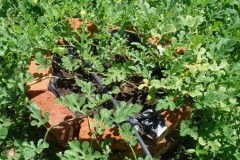
Four bricks high, layer of compost at the bottom and filled to the brim with sand.
If you are planning to grow on a larger scale, do not use bricks, they are not really practical. Recycle discarded tires - just stack up two.
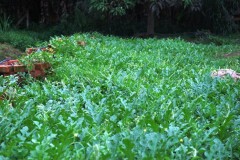
Lush watermelon plants fed farm-made compost tea once a week.
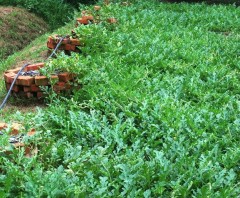
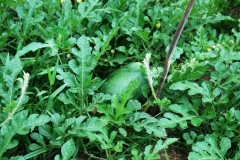
Heavy, succulent fruits on the way.
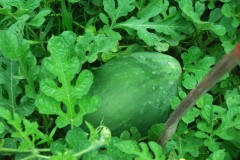
Things will go wrong, just don't throw out the baby with the bath water.
There are many possible reasons why the watermelon plant may not do well. Try to investigate, keep records, and modify and adapt.
One of the most common reasons is wrong seed. You will be surprised how often this mistake is made. Seeds from Japan, Taiwan, etc are not suited for growing naturally in our climate though they may thrive doing so in their home countries. We need to duplicate the conditions back home but that's not a route that sustainable farming should take.
11:05 Posted in Permaculture | Permalink | Comments (0) | Tags: raised beds, key hole garden, permaculture, watermelon
Apr 28, 2010
Outsmarting a wild boar...
Wild boar is a perpetual problem at our farm. They break through fencing and get at the chickens, they dig up all those lovely yams and sweet potatoes, they damage our vegetable plots digging up earthworms for desert.
All kinds of suggestions have been given to us; shoot them, poison them, trap them, etc. We reject outright killing. Trapping, etc never works; they're too wary.
Then they played with this beautiful pegaga patch and turned it into a mud-bath:
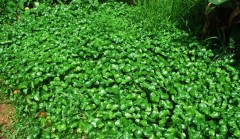
We were too distraught to remember to take a picture of the mud-bath.
We rehabilitated the patch twice but each time the pigs came in and turned it into mud again.
Then we sat and decided to think like a pig: it's dark, we can't look upwards to see the sky, we can only see directly in front, sideways and down. Now what if we see something totally dark in front would we be foolhardy enough to plunge ahead or would we move sideways looking for a path?
And we came up with this:
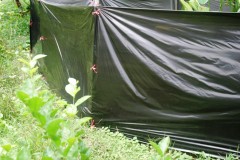
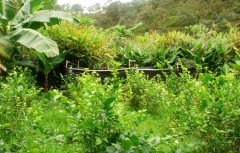
This was how the rehabilitated patch looked like after a week in the 'dark zone' (the red laterite mud has been topped with compost):
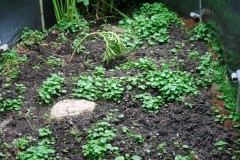
And this is signs of the pigs going in circles around the 'dark zone'. Note the mud!
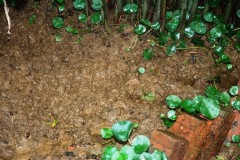

And this is the patch today after two weeks. Warms the heart. The possibility are endless! And we don't have to take a life or lives to co-exist. Remember, a life is still a life.
18:47 Posted in Blog | Permalink | Comments (4) | Tags: wild boar, pigs, trapping a wild boar
Apr 26, 2010
Permaculture is Bananas
Banana plants (it's a giant herb) can make their own food, retain water, and in our farm continuously produce 20 to 40 kg bunches without significant input.
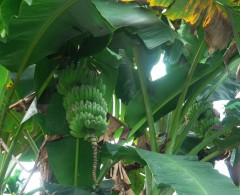
Banana plants at our farm. Producing fruits year after year in the same spot without replanting.
Nowadays farmers grow rows and rows of tissue-cultured clones. These require high fertiliser and fungicide inputs.
At our farm, the banana epitomises permanent agriculture. We use our human intelligence to plant them at the right place - they like moisture and organic material. They will form a clump - trim the clump to about 4 to 5 plants so that they will produce reasonable sized bunches
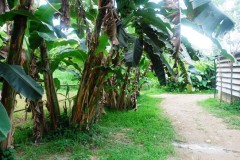
A banana clump serves as a heat absorber. They cool down the earth due to their ability to retain water and reduce radiation of heat to buildings due to their shady leaves.
The centre of the clump hosts myriad microbes and earthworms due to its dark and moist conditions rich in organic matter. They quickly break down fallen leaves, dead trunks, etc into humus and then release these nutrients back to the clump as food. We only need to occasionally supplement with some compost and some chopped dead trunks.
We plant tuba or derris elliptica in the centre. The clump provides all the nutrients that the derris require. We don't even need to water the derris.
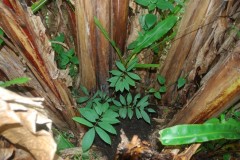
Derris in the clump :).
We have found that gingers do well in the clumps too. Gingers love organic matter and moisture. We are now planting ginger in all the clumps in the farm as a cash crop.
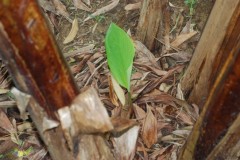
This temu kunci is growing at a faster rate than others planted outside the clump.
We, humans, have a choice - clear the land, plant rows and rows of clones and hybrids, feed them with synthetic nitrogen-based fertilisers and spray them with fungicides and due to the low contribution margin for such crops, go for 'volume', ie clear up more land to generate this 'volume';
Or go the permaculture way - use nature intelligently and work with nature to produce food for us for generations. We may not be rich in the short term, but we will be around for a far longer time. Multiple this idea by 100,000 farms and the landscape of the Earth's future changes!
16:44 Posted in Permaculture | Permalink | Comments (4) | Tags: permaculture, bananas, raised beds, compost, derris elliiptica, temu kunci, boesenbergia rotunda